
By Jennifer Allyn
AI is rapidly reshaping radiology, medicine and health care, with applications spanning diagnostics, treatment and workflow optimization. The accelerating development and adoption of AI technologies in imaging brings critical regulatory, ethical and patient safety considerations to the forefront.
During a Tuesday session, U.S. Food and Drug Administration (FDA) experts reviewed the current regulatory structure for AI-enabled medical tools, examined the challenges of balancing innovation with patient safety and physician accountability.
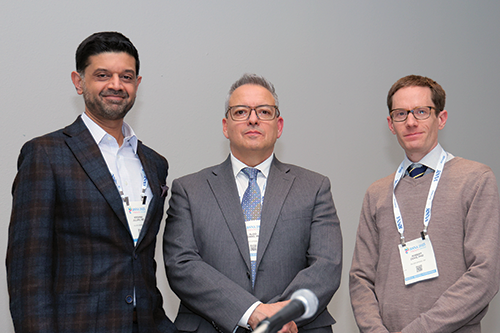
The FDA employs a risk-based approach to medical devices, with particular emphasis on technologies whose performance could jeopardize patient safety if they fail to operate as intended.
As of July, the FDA’s public list of AI-enabled medical devices includes 1,247 approved technologies.
“More than 75% of these devices are related to radiology,” said Robert Ochs, PhD, director, Office of Health Technology and Office of Radiological Health at the FDA. “These include devices for image segmentation and quantitative measurements, those that assist in image acquisition, those that aid in image triage and those that aid in image interpretation.”
Dr. Ochs reviewed the total product life-cycle approach, describing how AI-based devices are evaluated in both pre-market and post-market stages.
AI performance evaluation of radiology-specific devices may involve standalone testing—benchmarking the algorithm without an end-user—to assess generalizability, as well as controlled studies that include radiologists.
He noted that FDA guidance and public databases are available to support developers preparing submissions.
“Postmarket information and real-world evidence can support an ongoing assurance of AI-enabled device safety and effectiveness,” Dr. Ochs summarized.
Regulatory science tools, a relatively new category of resources, have been in use for only about six years, explained Aldo Badano, PhD, director, Division of Imaging Diagnostics and Software Reliability at the FDA.
“They are voluntarily used in early stages of research and development and are intended to ease the evaluation burden on the innovators,” Dr. Badano said. “Not all, but many innovators can develop technology, but they don’t have the bandwidth to develop the methodologies for assessing the tools. By providing these tools, the innovators can focus on developing highly valuable products.”
He highlighted the growing importance of synthetic data in evaluating AI-enabled imaging devices.
“No matter how many images from patients we have, it will not be enough to test all the promising algorithms,” Dr. Badano said. “At some point we have to compliment those data sets and synthetic data is one of the potential solutions.”
Dr. Badano continued, “The field of synthetic data is really exploding, particularly for radiology. Not all synthetic data is the same, however.” To illustrate his point, Dr. Badano concluded with a comparison of knowledge-based and generative models to demonstrate the varying reliability of synthetic data sources.
Krishna Juluru, MD, medical officer, Digital Health Center of Excellence at the FDA, discussed oversight of device modifications. “Modifications to devices can necessitate a new marketing submission or a pre-determined change control plan to FDA,” Dr. Juluru said.
A pre-determined change control plan (PCCP) outlines anticipated device modifications, the methodology for developing, validating and implementing those changes, and an assessment of their impact. PCCPs, which can be applied to radiology-specific devices, are frequently used to retrain or optimize AI algorithms with additional datasets.
The FDA has received more than 350 PCCP submissions and has authorized more than 110 devices incorporating them.
“Companies should think proactively about PCCPs and engage with the FDA as early as possible if they have changes to a device that is already approved,” Dr. Juluru said.
Developers interested in AI-enabled devices and those utilizing PCCPs can consult the FDA’s public databases for additional information.
Moderated by Libby O’Hare, PhD, director of RSNA Government Relations, the session was sponsored by the RSNA Government Relations Committee.
Access the session, “Discussing the FDA's Approach to Regulating AI-Enabled Devices in Radiology: Challenges, Innovations, and Other Considerations,” (T8-RCP18) on demand at RSNA.org/MeetingCentral.
© 2025 RSNA.
The RSNA 2025 Daily Bulletin is the official publication of the 110th Scientific Assembly and Annual Meeting of the Radiological Society of North America. Published online Sunday, November 30 — Thursday, December 4.
The RSNA 2025 Daily Bulletin is owned and published by the Radiological Society of North America, Inc., 820 Jorie Blvd., Suite 200, Oak Brook, IL 60523.
